The short answer
Efo riro is a rich, savoury Nigerian vegetable stew from the Yoruba people of the southwest, made with leafy greens cooked in a base of blended peppers, onions and palm oil, with meat, fish and seafood. The name means, roughly, stirred leafy greens in Yoruba, and the dish is built around African leafy vegetables such as efo shoko or efo tete, though spinach is a common substitute abroad. Unlike a thin vegetable side, efo riro is a hearty, well-seasoned stew, thick with greens and protein, and it is eaten with rice or with swallows such as pounded yam, eba and amala. In the UK the greens, palm oil, peppers and other ingredients are sold by African and Caribbean food shops.
What to remember
- It is eaten with rice or with swallows such as pounded yam, eba and amala, and the ingredients are easy to find in the UK.
- It is a hearty, well-seasoned stew rather than a light side, thick with greens and protein.
- It is traditionally made with African greens such as efo shoko or efo tete, with spinach as a common substitute abroad.
- The name means, roughly, 'stirred leafy greens' in Yoruba, and it comes from southwestern Nigeria.
- Efo riro is a rich Yoruba stew of leafy greens cooked in blended peppers, onions and palm oil with meat and fish.
For Yoruba and Nigerian families in Britain, efo riro is deep, everyday comfort. It is the smell of palm oil, peppers and locust beans filling the kitchen, the pot of rich green stew on the stove, and the pairing of soft amala or pounded yam with a generous scoop of efo. It belongs to Sunday meals, to the food of mothers and grandmothers, to the table where family gathers, and cooking it far from home brings that whole world of warmth and flavour into a British kitchen.
There is heritage and pride in it too. Efo riro is a dish that turns nourishing greens into something rich and celebratory, a skill carried through generations of Yoruba home cooks, and a well-made pot, thick with greens, meat and fish and properly seasoned, is something to be proud to serve. Sharing it with family who grew up on it, or introducing a friend to their first taste with a soft swallow, is an act of welcome and belonging. That combination of nourishment and generosity is the quiet gift of efo riro.
What is Efo Riro?
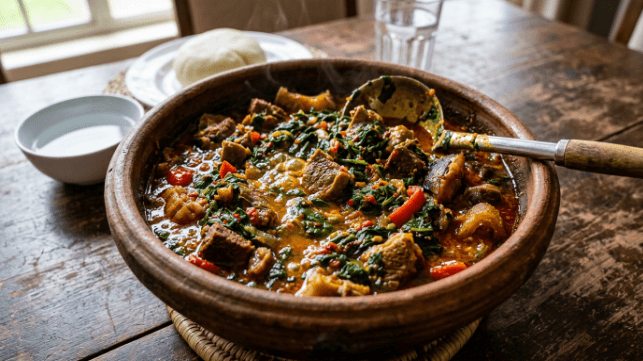
Efo riro is one of the best-loved stews of Yoruba cooking, and its name tells you what it is: in Yoruba, efo means leafy greens or vegetables, and riro refers to stirring, so the dish is essentially a rich, stirred vegetable stew. But calling it a vegetable stew undersells it, because efo riro is deeply savoury and substantial, built on a well-seasoned base of blended red peppers, Scotch bonnet, onions and palm oil, and loaded with greens and a generous mix of meat, fish and seafood.
The result is a thick, flavourful stew, red-orange from the palm oil and peppers and green from the leaves, that is far more than a simple side of greens. It is a proper main dish, the kind that anchors a family meal, and it is a staple in Yoruba homes and at gatherings. Its combination of nourishing greens and rich, spicy, protein-filled sauce is exactly what makes it so satisfying and so popular.
Efo riro is a cornerstone of Yoruba and Nigerian cooking, and you can see the wider table it belongs to in our guide to Nigerian food.
The Greens and Ingredients
The heart of Efo riro is its greens, and traditionally these are African leafy vegetables. The classic choices are efo shoko, a type of Lagos spinach, and efo tete, a kind of amaranth, which have a robust texture and flavour that hold up well in the stew. Outside Nigeria, where these exact greens can be harder to find, spinach and other sturdy leafy greens such as spring greens or kale are common and perfectly good substitutes, giving a stew in the same spirit even if the leaf differs slightly.
Around the greens goes a well-built base. Red bell peppers and scotch bonnets are blended with onions and tomatoes and cooked down in red palm oil, which gives efo riro its characteristic colour and depth, and you can read more about that oil in our guide to palm oil. Locust beans, called iru, are a traditional seasoning that adds a distinctive savoury note, and the stew is enriched with assorted meat, smoked or dried fish, stockfish and sometimes prawns. Because it so often contains fish and seafood, anyone with an allergy should check what a particular pot contains.
Efo-riro Versus Egusi
People sometimes group efo riro with other Nigerian soups and stews, so it helps to see how it compares, especially with egusi. Egusi soup is thickened with ground melon seeds, which give it its characteristic soft clumps and nutty richness, and while it usually contains greens, the melon seed is the defining ingredient. Efo riro, by contrast, is all about the leafy greens themselves, with no melon seed thickener, so it is greener, lighter in body and more clearly a vegetable stew, even though it is still hearty. You can read about egusi in our guide to egusi soup.
The two also play slightly different roles on the table, though both are eaten with swallow or rice. Efo riro can double as a stew served over rice or as a soup for swallow, while egusi is most often a soup for swallowing. Both are rich, both are savoury, and many households make both, choosing between them by mood and occasion. Knowing the difference simply helps you pick the right one for what you are cooking and buy the right key ingredient.
How Efo-riro is Eaten
Efo riro is versatile in how it is served, which is part of its appeal. It is very commonly eaten with swallows, the soft starchy foods that carry Nigerian soups and stews, such as pounded yam, eba made from garri, and amala, and you tear off a piece, scoop up the stew and eat the two together. Served this way it is a filling, traditional meal, and it pairs beautifully with the smooth swallows we cover in our guide to pounded yam.
It is also excellent with rice, whether plain white rice or alongside jollof, and some people enjoy it simply with boiled yam or plantain. Because it is thick and well seasoned, a little goes a long way, and it keeps and reheats well, which makes it a practical dish to cook for the week. However it is served, efo riro delivers a generous helping of greens along with plenty of flavour, which is a big reason Nigerian families return to it so often.
Where can I Buy the ingredients in UK?
Making efo riro at home in Britain is very doable, and the ingredients are increasingly easy to find. African and Caribbean food shops sell the greens, whether fresh African leaves when available or frozen and packaged spinach and other greens that work well as substitutes, along with red palm oil, scotch bonnet, locust beans, dried and smoked fish, stockfish, crayfish and seasoning. Buying frozen chopped spinach is a convenient shortcut that many home cooks rely on.
The shopkeeper can point you to the right greens and to iru if you want the traditional seasoning, and everything for the dish can usually be found in one visit. You can find African food stores near you or look up Caribbean food stores near you. If you would rather eat it out, many Nigerian restaurants serve efo riro with a choice of swallows or rice.
Frequently asked questions
What is Efo riro?
Efo riro is a rich Yoruba vegetable stew from southwestern Nigeria made with leafy greens cooked in a base of blended peppers, onions and palm oil, with meat, fish and seafood. The name means, roughly, 'stirred leafy greens' in Yoruba, and it is a hearty, well-seasoned stew rather than a light side.
What greens are used in Efo riro?
Traditionally African leafy greens such as efo shoko, a Lagos spinach, and efo tete, a type of amaranth, which hold up well in the stew. Outside Nigeria, spinach and other sturdy greens like spring greens or kale are common and perfectly good substitutes, giving a stew the same spirit.
What is the difference between Efo riro and egusi?
Egusi soup is thickened with ground melon seeds, which give it soft clumps and a nutty richness, while efo riro is built around the leafy greens themselves with no melon seed thickener, so it is greener and more clearly a vegetable stew. Both are rich and savoury and eaten with stew or rice.
What do you eat Efo riro with?
Very commonly with swallows such as pounded yam, eba and amala, tearing off a piece to scoop up the stew is also done with plain or jollof rice or with boiled yam or plantain. It is thick and well seasoned, keeps and reheats well, and a little goes a long way.
Where can I buy the ingredients in the UK?
African and Caribbean food shops sell the greens, fresh or frozen, along with red palm oil, scotch bonnet, locust beans, dried and smoked fish and seasoning. Frozen chopped spinach is a convenient substitute, and the shopkeeper can point you to iru if you want the traditional locust bean seasoning. African Stores lists African and Caribbean food shops across the UK, so you can find one near you.