The short answer
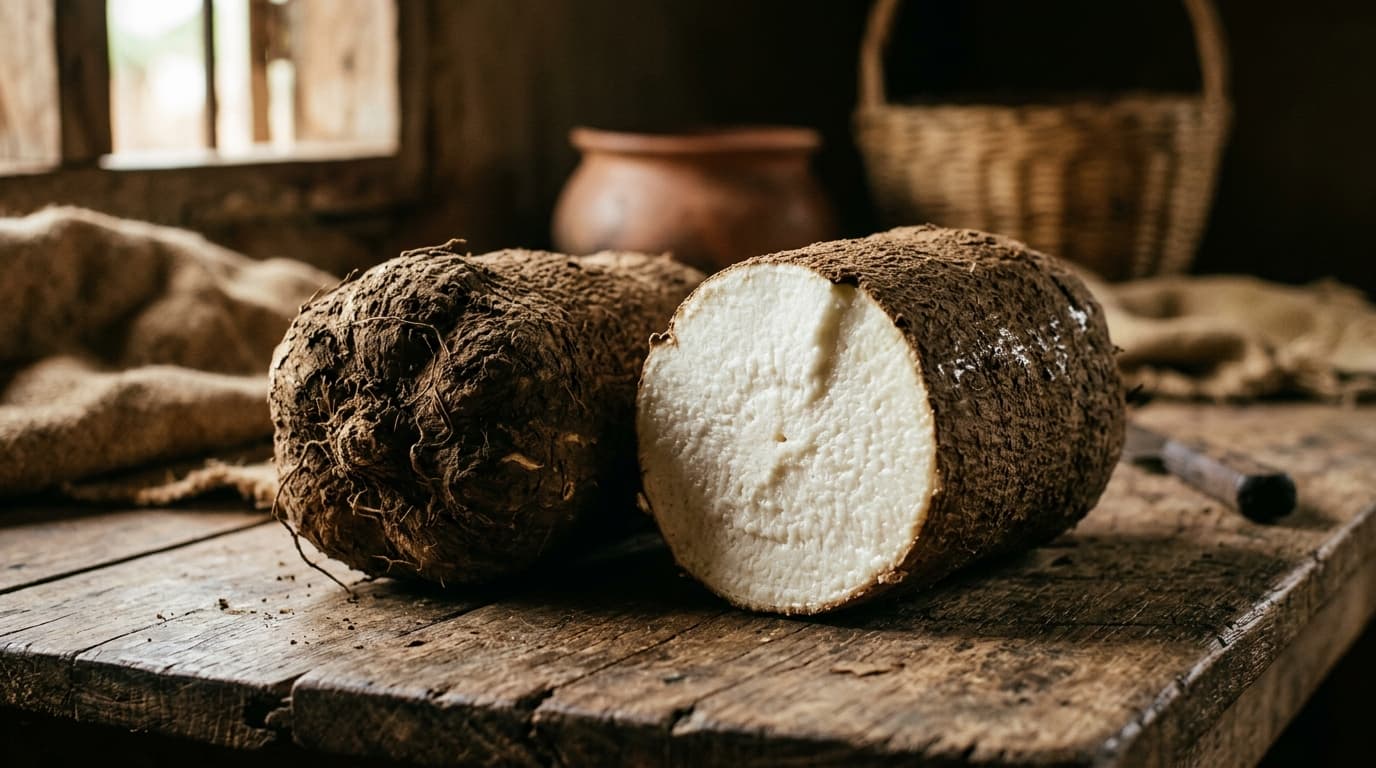
Yam is a large, starchy root vegetable, or tuber, that grows on a climbing vine and forms one of the great staple foods of West Africa. The true yam most people mean is brown and rough-skinned on the outside, with firm white or pale flesh inside, and it can grow very large, sometimes longer than an arm. It is not the same thing as the sweet potato that British shops sometimes label as yam, and the two are not even closely related. Yam is boiled, pounded, roasted, fried or made into flour, and it sits at the centre of dishes such as pounded yam and egusi soup. In the UK it is sold whole or in sections by African and Caribbean food shops, often labelled puna or white yam.
What to remember
- Yam is a large, starchy tuber that grows on a vine, with rough brown skin and firm white flesh inside.
- It is a staple food across West Africa, especially Nigeria and Ghana, where it carries real cultural weight.
- Yam is not the same as sweet potato, despite the confusing labels used in some Western shops.
- It is boiled, pounded, roasted, fried or dried into flour, and it anchors dishes like pounded yam with egusi soup.
- In the UK it is sold whole or in cut sections by African and Caribbean food shops, usually as white or puna yam.
For West Africans in Britain, yam carries a particular kind of homesickness and comfort all at once. It is the smell of a pot boiling on a Sunday, the effort and rhythm of pounding, the sight of a smooth white mound of pounded yam next to a bowl of egusi or ogbono soup. It belongs to childhood kitchens, to grandmothers, to festivals marking the new harvest, and to the ordinary weeknight meals that quietly hold a family together. To cook yam far from home is to bring a piece of all of that into a British kitchen.
There is pride in it too. Buying a proper yam, peeling and boiling and pounding it, and setting it down for people who understand what it means is a small act of continuity. It says that the food, and the culture it comes from, made the journey and is still here. For anyone tasting real yam for the first time, it is an easy introduction to why West Africa loves this humble, mighty tuber so much. That is the quiet gift of yam, and it travels well.
What is yam?
Yam is a tuber, the swollen underground part of a climbing vine that stores the plant's energy, and it is that store of starch that makes it such good eating. The kind at the heart of West African cooking is large and cylindrical, with a rough, bark-like brown skin and dense white or cream flesh that firms up as it cooks. A single yam can be surprisingly heavy, and shops often sell it cut into sections because a whole one is more than most households need at once.
The flavour is mild, earthy and faintly sweet, closer to a floury potato than to anything sugary. That mildness is exactly why it works so well as a staple. It carries rich, spicy soups and stews without competing with them, and it takes on whatever it is cooked with. In much of West Africa yam is not a side dish but the base of the meal, the thing everything else is built around.
Yam belongs to a much bigger table, and you can see where it fits in our guides to Nigerian food and West African food.
Is yam same as sweet potato?
This is the single most common mix-up, and it is worth clearing up plainly. In parts of the United States, and sometimes on British shelves, the soft orange-fleshed sweet potato is labelled a yam. It is not one. True yam and sweet potato come from completely different plant families, and once you have handled both, you will never confuse them again.
The differences are easy to see. Real yam has rough, scaly brown skin like tree bark, firm white or pale flesh, and it grows long and heavy. Sweet potato has smooth, thin skin, is usually orange inside, tastes distinctly sweet, and is much smaller. When an African recipe calls for yam, it means the true yam, and using orange sweet potato in its place will give you a completely different, sweeter result. If you are shopping in an African or Caribbean food shop and ask for yam, the true tuber is what you will be handed.
Types of yam
There are many species of yam, but a few turn up most often in UK shops. White yam, sometimes sold as puna yam, is the everyday favourite for West African cooking, with firm white flesh that boils and pounds beautifully. Yellow yam, more common in Caribbean cooking, has pale yellow flesh and a slightly different texture, and it is a familiar sight in Jamaican dishes.
You may also come across water yam, or Chinese yam, which is softer and more watery and behaves differently in the pot. For most Nigerian and Ghanaian recipes, and certainly for pounding, white or puna yam is what you want, and it is the type most African food shops keep in stock. A quick word with the shopkeeper will steer you to the right one for whatever you are cooking.
How is yam prepared?
Yam is endlessly versatile, which is a big part of why it became a staple. The simplest way to eat it is peeled, cut into chunks, boiled in salted water until tender, then served with a stew, a sauce of peppers and tomato, or fried egg and vegetables in the dish many Nigerians know as yam and egg. Boiled yam is honest, filling everyday food.
Pounding is where yam becomes something special. Boiled yam is pounded until it turns into a smooth, stretchy, elastic mound called pounded yam, a swallow eaten by tearing off a piece and dipping it into soup. This is the classic partner to rich West African soups, and you can read the full picture in our guide to pounded yam and fufu. Beyond that, yam is roasted over coals, fried into crisp chips, cut into a peppery pottage, or dried and milled into yam flour, known as elubo, which is stirred into a darker swallow called amala. Few staples stretch across so many dishes.
Yam and culture
In West Africa yam is not only food, it is heritage. In many Igbo communities of southeastern Nigeria, and among other peoples across the region, the yam is treated as a symbol of wealth, hard work and the harvest itself. The New Yam Festival, known as Iri Ji or Iwa Ji, marks the end of the growing season and the first eating of the new crop, and it is celebrated with thanksgiving, music, masquerade and feasting. A man's store of yams was once a measure of his standing.
That weight of meaning is a reminder that yam is woven deep into family and community life. It appears at celebrations, at everyday meals and at the table where generations gather, and for people who grew up on it, cooking yam is a way of holding on to all of that. Food this central to a culture is never just something on a plate.
Where to buy yam in the UK?
Real African yam is stocked by African and Caribbean food shops across Britain, and this is by far the most reliable place to find the true tuber rather than a mislabelled sweet potato. Yams are usually piled up whole or sold in cut sections, so you can buy as much as you need, and the shopkeeper can tell you whether you are looking at white, puna or yellow yam. You will also find yam flour, or elubo, on the same shelves for anyone who wants to make amala.
Larger cities with settled West African communities have plenty of choice, and you can find African food stores in London or look up African food stores in Manchester to find a shop near you. If you are new to buying yam, ask how fresh a piece is and check that the cut end looks clean and white rather than dry or discoloured, and you will come away with something worth cooking.
Frequently asked questions
Is yam the same as sweet potato?
No. Despite the labels used in some shops, true yam and sweet potato are from entirely different plant families. Real yam has rough brown bark-like skin and firm white flesh, grows large, and tastes mild and earthy. Sweet potato has smooth skin, is usually orange inside, is much smaller, and tastes sweet. When an African recipe says yam, it means the true tuber.
What does yam taste like?
Mild, earthy and only faintly sweet, closer to a floury potato than to anything sugary. That neutral flavour is exactly why it works as a staple, because it carries rich, spicy soups and stews without overpowering them.
How do you cook yam?
It can be boiled, pounded into pounded yam, roasted, fried into chips, made into a peppery pottage, or dried and milled into yam flour for amala. Boiled yam with a stew or fried egg is the simplest everyday version, while pounded yam with soup is the classic celebration dish.
What is puna yam?
Puna yam is a name often used for white yam, the firm white-fleshed variety that is the everyday favourite for West African cooking and the best type for boiling and pounding. It is the type most African food shops in the UK keep in stock.
Where can I buy real yam in the UK?
African and Caribbean food shops are the most reliable source, selling true yam whole or in cut sections, along with yam flour. Larger cities with West African communities have the widest choice, and the shopkeeper can help you pick the right type for your recipe.