The short answer
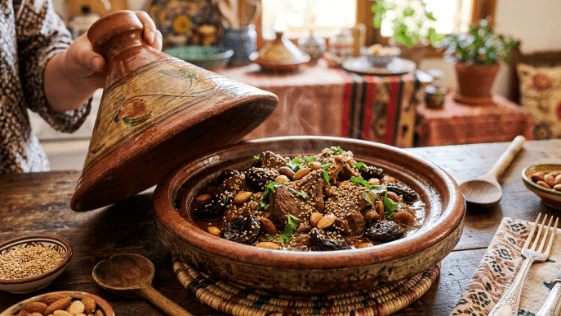
A tagine is two things that share one name. It is the shallow earthenware pot with a tall conical lid used across Morocco, Algeria, Tunisia, and Libya, and it is the slow-cooked stew of meat or vegetables prepared inside that pot. The cone traps rising steam, cools it, and returns it to the food, so ingredients braise gently in very little liquid. Classic versions include lamb with prunes and almonds and chicken with preserved lemon and olives, usually eaten with bread or couscous.
What to remember
- You can find real clay tagines and North African spices in African and Caribbean food shops across the UK, so you do not have to travel to cook one.
- Sweet and savoury sit happily together here, from prunes and honey to preserved lemon and green olives.
- The flavour lives in the spice blend and the long, slow heat, not in a rush of stock.
- The tall lid is the whole trick. Steam rises, condenses and drips back down, so food stays moist with hardly any added water.
- One word, two meanings: the tagine is both the conical clay pot and the dish you cook in it.
There is a particular kind of welcome in a tagine. In North African homes the pot is not weeknight fuel to be eaten alone; it is set down in the middle of the table so that everyone leans in together, breaking bread and reaching into the same warm center. That shared plate carries meaning. It says there is enough, and you are part of it.
The cooking itself teaches patience. A tagine cannot be rushed, and that slowness is a kind of hospitality, hours of gentle heat are given so that guests can be met with something tender and generous.
The blend of sweet and savoury, honeyed prunes against soft lamb, and sharp preserved lemon against mild chicken speaks of centuries of trade across the Sahara and the Mediterranean, of spice routes and market stalls and family recipes handed down without ever being written. For North Africans far from home in Britain, lifting that conical lid over a full pot is a way of setting the old table again, wherever the kitchen happens to be.
What is tagine
Say the word "tagine," and you could mean the pot or the plate. The two grew up together. The pot is a piece of North African kitchen design that has barely changed in centuries: a wide, shallow base with a tall lid shaped like a cone or a rounded dome.
The dish is what happens inside it, a slow braise of meat, poultry, fish, or vegetables cooked low and unhurried until everything turns tender and the sauce thickens into something you want to mop up.
It belongs to the whole of the Maghreb, the northwest shoulder of Africa. Morocco is the name most people reach for, but Algeria, Tunisia and Libya all have their own tagines, and every family cooks theirs a little differently.
If you enjoy this, the wider world of [Moroccan food](/blog/moroccan-food) and [African food](/blog/african-food) is full of the same patience and warmth.
How the Pot Works
The clever part is the lid. As the food heats, moisture rises as steam and hits the cool inner walls of the cone. There it condenses back into water and trickles down the sides, returning to the pot. That gentle circle means you start with only a small amount of liquid, sometimes little more than the water in an onion, and the dish never dries out. The result is meat that pulls apart softly and vegetables that hold their shape while soaking up the sauce.
Because the heat is low and steady, a tagine rewards time. This is not a dish to hurry. An hour or two over a modest flame lets tough cuts relax and lets the spices settle into everything. Traditionally the pot sits over charcoal, though a diffuser on a home hob does the same job.
The Classic Tagines
Kefta tagine is made with spiced minced meatballs simmered in a tomato sauce, often with an egg cracked in near the end. And vegetable tagines, carrots, courgettes, chickpeas, squash, and potatoes are everyday cooking across the region, quietly proving that the pot never needed meat to shine.
Lamb with prunes and almonds is the celebration dish, sweet and deep, the meat glazed with honey and cinnamon and scattered with fried almonds and sesame seeds. Chicken with preserved lemon and olives sits at the other end, bright and salty and savoury, the preserved lemon giving a sharp tang you cannot get any other way.
Being made with different unique ingredients, there is no single tagine, but a handful of combinations turn up again and again.
The Spices it Carries
North African cooking leans on warmth rather than fierce heat. The signature blend is ras el hanout, whose name means something close to "top of the shop," a mix of spices a merchant builds from many ingredients that can include cinnamon, cumin, coriander, ginger, turmeric, black pepper, cardamom, clove, and dried rosebud. No two blends are identical.
Alongside it you will find ground ginger for a gentle lift, cumin for earthiness, and saffron, the costly red threads that lend colour and a faint honeyed perfume. Fresh coriander and flat-leaf parsley go in towards the end.
The point is balance: sweet, savoury and aromatic notes leaning on one another rather than any one shouting.
How Tagine is Eaten
A tagine is made to be shared. The pot comes to the table as the serving dish, the lid lifted to a rise of steam, and everyone eats from the same center. Bread does much of the work. Torn pieces of khobz, the round Moroccan loaf, become the spoon, scooping up sauce and meat.
On other days the tagine is served with [couscous](/blog/couscous), the steamed semolina that soaks up the juices. Mint tea, poured tall and sweet, usually follows.
Choosing the Seasoning of a real Clay Tagine
If you want to cook one properly, you have a choice to make. A traditional glazed clay or terracotta tagine gives the most unique result and a faint earthiness to the food, but it needs care. A new clay pot must be seasoned before its first use: submerge it in water for a couple of hours, then rub the inside with olive oil and warm it slowly in a low oven so it does not crack.
Always bring it up to temperature gently and never drop a cold pot onto a hot flame or a hot pot into cold water, since the shock will split it. Many clay tagines also need a heat diffuser on a gas or electric hob.
A cast iron tagine, often with an eenameledbase and a clay or cast lid, is the practical alternative. It can go straight onto any hob, holds heat beautifully, and is far harder to break, though purists will say it loses a little of the character. For a first tagine, cast iron forgives more; for the real thing, seasoned clay is worth the patience. Either way, low and slow is the rule.
Where to Find a Tagine and the Ingredients in UK
You do not need a trip to Marrakech to start. Tagine pots, both clay and cast iron, turn up in African and Caribbean shops, Middle Eastern and halal grocers, and specialist cookware stores across British cities.
The same shops are where you will find the pantry that makes a tagine sing: ras el hanout, preserved lemons, good green and violet olives, saffron, whole spices, dried fruit, couscous, and semolina.
To track down a shop near you that stocks North African and wider African ingredients, browse the food stores listed in [London](/african-food-stores-in-london) and beyond. And if you would rather let someone else do the slow cooking first, so you know what you are aiming for, look up [African restaurants near you](/african-restaurants-near-me) and find a kitchen serving the real thing.
Frequently asked questions
Is a tagine a pot or a dish?
Both, and that is the fun of the word. The tagine is the conical clay pot, and it is also the slow-cooked stew you make in it. When someone says they are making a tagine, they usually mean the meal.
Do I really need a tagine pot to cook one?
The flavours come from the spices and the slow, gentle heat, so a heavy casserole or Dutch oven with a tight lid will get you most of the way. A proper tagine pot simply does the job the way it has always been done, and it looks lovely on the table.
What is the difference between a clay and a cast iron tagine?
A clay tagine gives the most traditional result and a slight earthiness, but it needs seasoning, careful heating, and often a diffuser. A cast iron one goes straight onto any hob, holds heat well, and is much harder to break. For a first pot, cast iron is more forgiving.
What do you serve with a tagine?
Bread, most of all, torn and used to scoop up the sauce, or couscous to soak up the juices. Sweet mint tea afterwards finishes the meal in the North African way.
Where can I buy a tagine and the spices in the UK?
African and Caribbean shops, Middle Eastern and halal grocers and specialist cookware stores stock both the pots and the pantry, ras el hanout, preserved lemons, olives, saffron, and couscous. Look up a food shop near you to find them locally.